


Men Ahyaha Foundation – Egypt
Visual Arts and Crafts Curriculum
Designing a Community-Based Art Curriculum Built on Exploration, Environment, and Human Development
Designing a Community-Based Art Curriculum Built on Exploration, Environment, and Human Development
This project presents a model for designing a visual arts and crafts curriculum targeting children in Grades 3 and 4, within the context of a community school that seeks to support human development and nurture learners’ awareness of themselves and their communities through art.
This curriculum was developed for Men Ahyaha Association, based on an educational vision that sees visual arts not as a separate subject, but as part of everyday human experience and a tool for building self-confidence, self-expression, and a sense of belonging to the surrounding community and environment.
Project Context
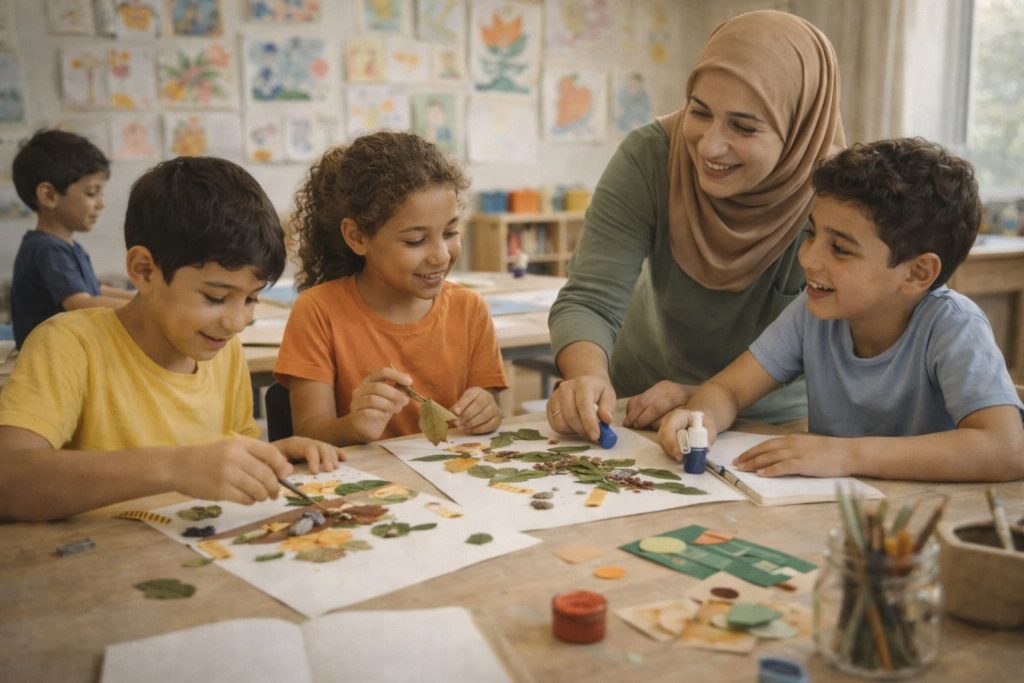
The curriculum is based on a deep understanding of the nature of community schools and the characteristics of their learners, where limited resources intersect with the richness of the local environment, including its natural materials, folk culture, and life experiences that are close to the child’s world.
The curriculum responds to the need for a learning experience that:
- Connects art to the learner’s everyday reality.
- Invests in environmental resources instead of relying on ready-made tools.
- Provides children with a safe space for expression, experimentation, and decision-making.
- Enhances their sense of value and ability to create.
Curriculum Approach
This curriculum is grounded in an educational approach that views:
- Art as an exploratory learning journey, not merely a final product.
- Artistic expression as a means of understanding the self and the world.
- Beauty as a value discovered in the nearby environment and everyday details.
- Authentic art learning as built on experience, practice, and reflection.
Project Objectives
This curriculum model aims to:
- Develop aesthetic awareness and artistic appreciation.
- Enable students to express their thoughts and feelings visually.
- Develop the capacities of reflection, exploration, and imagination.
- Equip students with design skills and idea-generation abilities.
- Strengthen self-confidence and respect for oneself and others.
- Support environmental and community awareness through art.
- Instill the values of collaboration, diversity, and responsibility.
Features of the Educational Solution
This curriculum is distinguished by several features derived from the design philosophy outlined in the project files, most notably:
A strong connection to the learner’s environment and social reality.
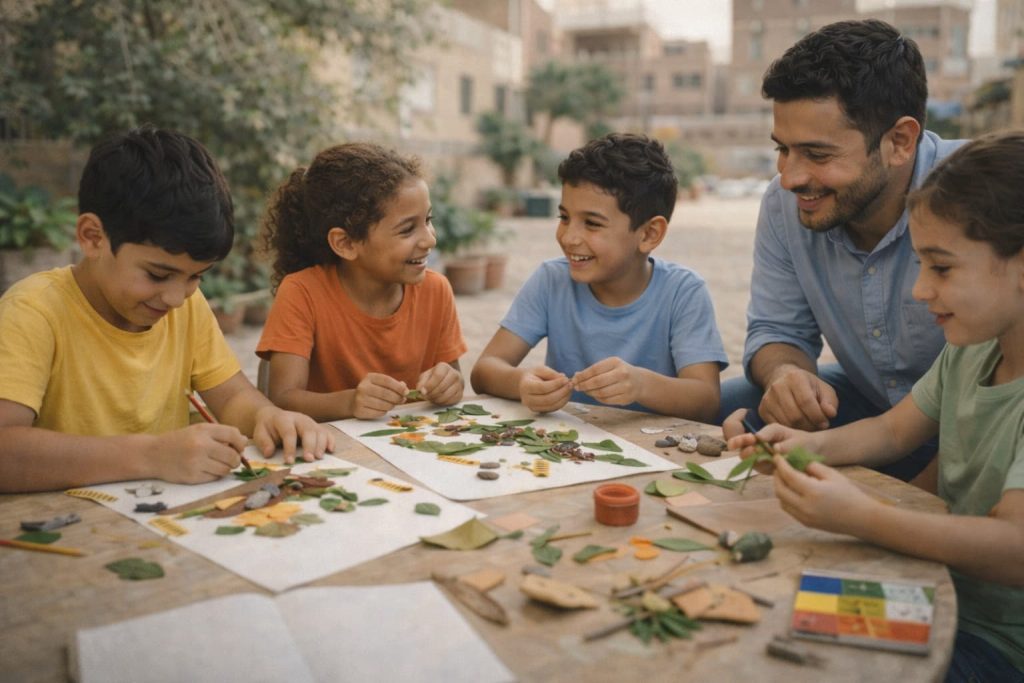
Utilizing natural materials and recycled resources.
Using expressive themes as an entry point for learning.
Project-based learning and collaborative work.
Taking into account individual differences and learners’ developmental characteristics.
Focusing on the learning process and artistic experience more than the final outcome.
Curriculum Components
The curriculum includes:
- Interconnected art learning units.
- Two-dimensional and three-dimensional art activities.
- Art projects that reflect students’ connection to their environment and community.
- Simple craft practices inspired by local culture.
- Supportive facilitator guidelines to help guide the artistic experience.
- Documentation and assessment tools that focus on students’ development and learning journey.
Target Audience
This model was designed to target:
- Students in Grades 3 and 4.
- Community schools and non-profit educational institutions.
- Educational initiatives that seek to connect art with identity and environment.
- Programs concerned with the holistic development of the child.
The Value Delivered by the Project
At EducQuest, we believe that
visual arts are a language for human development before they are a technical skill,
and that the community school is a real space for transforming the beauty embedded in the environment into a living learning experience.
EducQuest Philosophy
This project presents a model of EducQuest’s solutions in:
- Designing art curricula suitable for community-based contexts.
- Transforming local environmental resources into meaningful learning opportunities.
- Integrating art with values-based education and community awareness.
- Building learning experiences that strengthen confidence and belonging.
- Developing curricula that can be adapted to resource-limited environments.
مناهج إديكويست


